



For many businesses, structured cabling is out of sight and out of mind until performance problems begin affecting operations.
Organizations today rely on a growing ecosystem of connected technologies, including advanced wireless access points, IP security cameras, digital signage, IoT devices, and cloud-based applications. As these technologies continue to evolve, the infrastructure supporting them must evolve as well. That is why working with an experienced cabling partner like Bailiwick is critical when installing new systems or upgrading existing infrastructure.
Modern Technology Requires Modern Cabling
Low-voltage cabling systems can last between 10 and 20 years, but replacement cycles are rarely driven by the age of the cable itself. Instead, upgrades are usually triggered by increasing bandwidth demands, new technology deployments, and changing network standards – where the cable itself becomes the bottleneck.
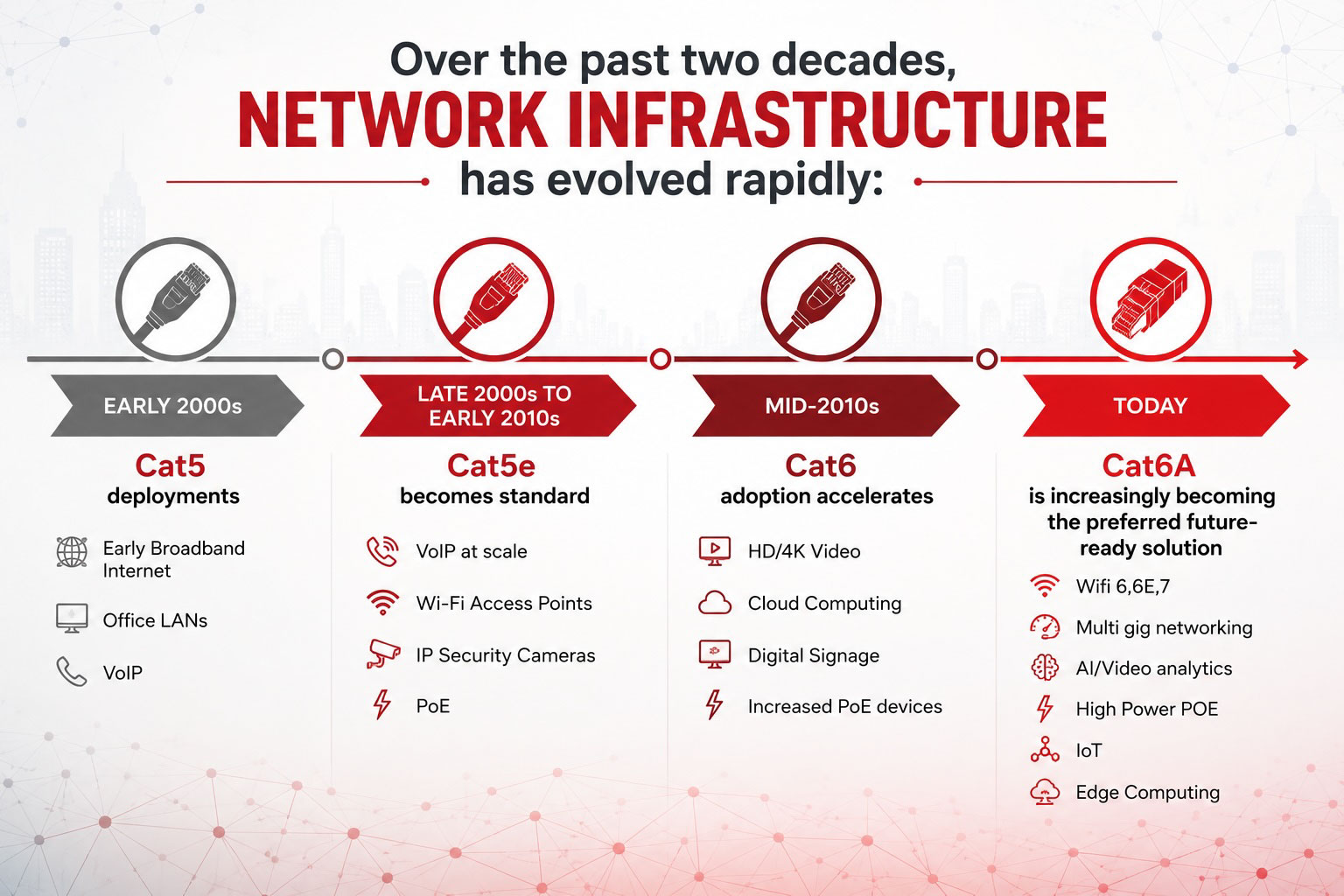
Many organizations that installed Cat5e infrastructure before 2015 are now entering upgrade territory, particularly as they deploy higher-performance technologies like Wi-Fi 6 and 7, high resolution surveillance cameras, digital media systems, multi-gig networking, and advanced Power over Ethernet (PoE) devices.
“Traditional Cat 5e infrastructure was designed to support 1 Gbps speeds, but as modern networks adopt higher-speed technologies, 10 Gbps capability is becoming increasingly important for long-term performance and scalability,” said Brady Caviness, Bailiwick Account Executive. “Upgrading to Cat6A not only supports higher data speeds but also provides more reliable delivery of higher-power PoE, thanks to improved heat management and reduced power loss, making it ideal for advanced connected devices.”
Without the proper infrastructure in place, businesses may not fully realize the performance benefits of their new technology investments.
Exceptional Technology Deployment.
Find out why companies trust Bailiwick for deployment of their large-scale digital technology initiatives.
Why Cabling Expertise (RCDD) Matters
Large-scale telecommunications and data communications projects are incredibly complex. Successful deployments require deep knowledge of copper and fiber-optic distribution systems, electrical infrastructure, wireless signal performance, local building codes, and evolving ICT industry standards.
This is where Registered Communications Distribution Designer (RCDD) certification becomes invaluable. RCDD certification is considered one of the most respected credentials in the information and communications technology industry. The certification demonstrates extensive expertise in designing and implementing structured cabling systems.
There are only about 7,500 RCDD certified professionals worldwide, making the credential both rare and highly respected. While many organizations may employ one or two RCDD certified professionals, Bailiwick has six RCDD certified designers and engineers on staff.
More importantly, Bailiwick’s RCDD certified professionals bring real-world field experience to projects. Bailiwick RCDD technicians average approximately 30 years of industry experience, combining technical design expertise with hands-on installation knowledge.
Nationwide Compliance and Consistency
Cabling regulations and certification requirements vary significantly between states and municipalities. Using installers without proper licensing can expose businesses to legal risk, project delays, and compliance issues. Bailiwick’s nationwide technician base helps to ensure compliance with local licensing and installation requirements.
“One of the most important advantages of working with a nationwide installation partner like Bailiwick is that our technicians are locally licensed in the state they are working. This helps to avoid legal and operational risks,” said Caviness.
Whether supporting a single facility or thousands of locations nationwide, businesses need assurance that installations are compliant, standardized, scalable, and aligned with long-term technology goals.
Building Infrastructure for the Future
Structured cabling is no longer simply about connecting devices. It is the foundation that enables modern business operations, digital transformation initiatives, and future technology growth.
“Cabling infrastructure is similar to highways in a growing city,” Caviness said. “The roads may still be paved, but when there are 10 times as many cars – everyone ends up sitting in traffic. At some point, you need to add additional lanes to handle the increased demand.”
For businesses investing in next-generation technologies, partnering with an experienced provider like Bailiwick helps ensure that the infrastructure beneath those technologies is designed to support performance, reliability, scalability, and long-term success.